

Be prepared before an audit becomes a reality. Trade enforcement is increasing, and Customs expects companies to demonstrate reasonable care through strong compliance programs and well-documented processes. The best time to identify compliance gaps isn’t during an audit – it’s…


Tariff Savings Case Study: Identifying $2M+ in Client’s Potential Savings
Tariff Savings Case Study: Identifying $2M+ in Client’s Potential Savings
April 8, 2026/
Most compliance engagements start with a signed contract. This one started with a refusal.
When a major U.S. importer issued a competitive RFP for trade compliance services, the conventional move would have been to sharpen our pencils, compete on price, and hope for the win. Instead, we realized the importer needed more than just another vendor. They needed a redesigned compliance process.
So, we took a step back, and that decision changed everything. What followed was an ongoing partnership that delivered over $2.7 million in identified tariff savings, 21 completed or active projects, and a compliance function that went from cost center to strategic asset. Here's how it happened, and what it means for how the industry thinks about sourcing expertise.
The Challenge
The RFP landed like most do: structured questions, price comparison fields, and predefined deliverables. On the surface, it looked like a straightforward sourcing exercise, but when we read between the lines, the real problem was hiding in plain sight.
This client actually needed a partner who could help them redesign compliance processes from the ground up, reduce global exposure, and build a model capable of generating long-term savings. They originally had short-term goals, but we knew that we could support them not just for the current quarter, but year after year.
A commoditized RFP process isn't designed to surface those kinds of needs. It rewards whoever fits the box best, not whoever can solve the actual problem. Participating on those terms would have locked both sides into a transactional relationship from day one. We believed that wasn’t a foundation for the kind of work that actually moves the needle.
The Solution
We declined to participate in the RFP. Instead, we proposed a direct conversation focused on their real goals, constraints, and where they wanted to be in three years. That shift in approach made all the difference.
Through those early discussions, the client arrived at their own conclusion: what they needed wasn't a low-cost vendor cycling through deliverables, but a strategic compliance partner. From there, they engaged us to lead a tailored operational compliance assessment, which was a far more meaningful starting point than any RFP could have provided. That assessment became the foundation for a multi-phase improvement program that's still growing today.
The Approach
We started where good work always starts: listening. Before we recommended anything, we sat down with their compliance, logistics, and finance teams to understand what was actually driving the business.
Using our compliance maturity framework, we mapped their current processes and identified what was holding them back. From there, we built a clear roadmap that balanced quick efficiency wins with longer-term structural improvements. The client came to us with roughly ten known issues and no clear path forward. We worked together to establish priorities, timelines, and a weekly cadence for status updates.
Those weekly meetings turned out to be one of the most valuable parts of the engagement. They became a space where new challenges surfaced, trust deepened, and the scope of the work expanded organically. We created two objective trackers: one for short-term projects, one for long-term planning. Accountability ran in both directions.
One moment that captures the spirit of the partnership was when we completed a Tariff Savings Analysis, identifying over $2.7 million in potential tariff savings. We equipped our main client contact with a presentation she could take directly to her leadership team. She enhanced it, owned it, and presented it confidently.
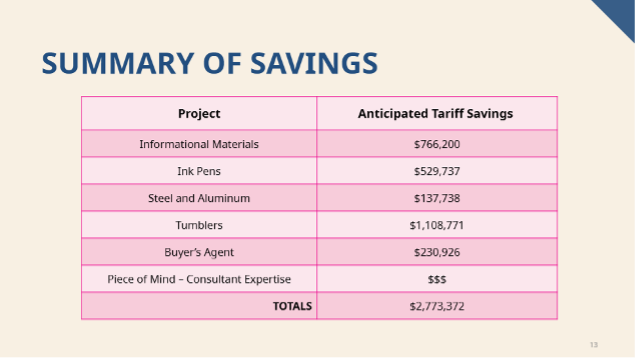
Tariff Savings Analysis, highlighting the projected financial impact and cost-saving opportunities available to their business.
The Impact
In just 10 months, we completed 20 projects and are currently working on a 21st. The results have been measurable: substantial, sustained cost savings through better process design, increased automation, and improved accuracy across both import and export operations.
Numbers only tell part of the story, though. The deeper shift was cultural. A compliance function that leadership once viewed primarily as overhead is now recognized internally as a business enabler and a genuine strategic asset. That kind of repositioning results from consistent execution, transparent communication, and a shared sense of ownership over outcomes.
The client has since expanded our partnership across multiple business units and uses this collaborative model as a benchmark for other service relationships.
Lessons for the Industry
This engagement offers a few honest observations worth sitting with.
The traditional RFP process often works against the buyer. When procurement structures are designed to evaluate vendors on price and predefined deliverables, they filter out the partners most capable of solving complex, evolving problems. If your compliance challenges are structural, a transactional sourcing process will probably get you a transactional solution.
Proximity and cadence matter. Weekly working sessions might sound like overhead, but in practice, they're where the real work gets done. It’s where trust accumulates, new problems get named before they become crises, and the relationship earns the right to grow.
Clients should be partners, not just recipients. Equipping the people inside the organization to carry the work forward is how compliance improvements actually stick. It empowers them to present to their own leadership, advocate for change, and own the results. Knowledge shared is leverage multiplied.
The compliance function deserves a seat at the strategy table. When it's treated as a cost to be minimized, that's exactly what it becomes. When it's invested in thoughtfully, it generates value that shows up on the balance sheet and in how leadership thinks about risk. This client's experience is proof of that.
Trade compliance done well goes far beyond checking boxes. It builds the kind of expertise, trust, and systems that keep you from being caught off guard now, and whenever the next challenge arrives. If you’re ready for a true compliance partnership, contact us here.
Related Posts

Case Study: How Tariff Engineering Expanded This Manufacturer’s Options
Cyril GauchetStrategic Trade Advisor, Star USA Key Takeaways Trade changes can affect much more than duty rates. They can quickly change supply chain decisions, expansion plans, and project ROI. Tariff engineering can uncover compliant ways to reduce tariff exposure, but proposed changes need careful review across classification, country of origin, manufacturing, packaging, and shipping. Sometimes…

Trade Compliance Investment Decisions: Modeling Risk, Cost, and Payoff for Your Leadership Team
Stephanie McLellandInternational Trade Specialist, Star USA Key Takeaways Trade compliance investments should reduce meaningful business risk. Strong business cases translate compliance needs into measurable financial impact. Consistent performance measurement helps leadership make better future investment decisions. Trade compliance investments are often treated as cost centers. If the leadership at your company asks, “Why does being compliant cost us…

Case Study: When a Valuation Question Turned Into a Six-Figure Wake-Up Call
Stephanie McLelland International Trade Specialist, Star USA A U.S. tractor distributor came to us with what seemed like a straightforward question: was their product valuation correct under customs regulations? With Section 232 tariffs raising the stakes on getting valuation right, their parent company overseas wanted to be sure nothing was being overvalued or undervalued. Before…

Data Quality in Trade Compliance: Governance Practices That Prevent Costly Errors and Delays
Melissa MerkleManager, Star USA Data quality is a major risk control across trade compliance. Data quality issues like inconsistent classifications, unreliable origin determinations, and incomplete valuation details can compound across systems. They may not be noticed for a while, but they surface as customs holds, duty miscalculations, or enforcement actions. The good news is that…